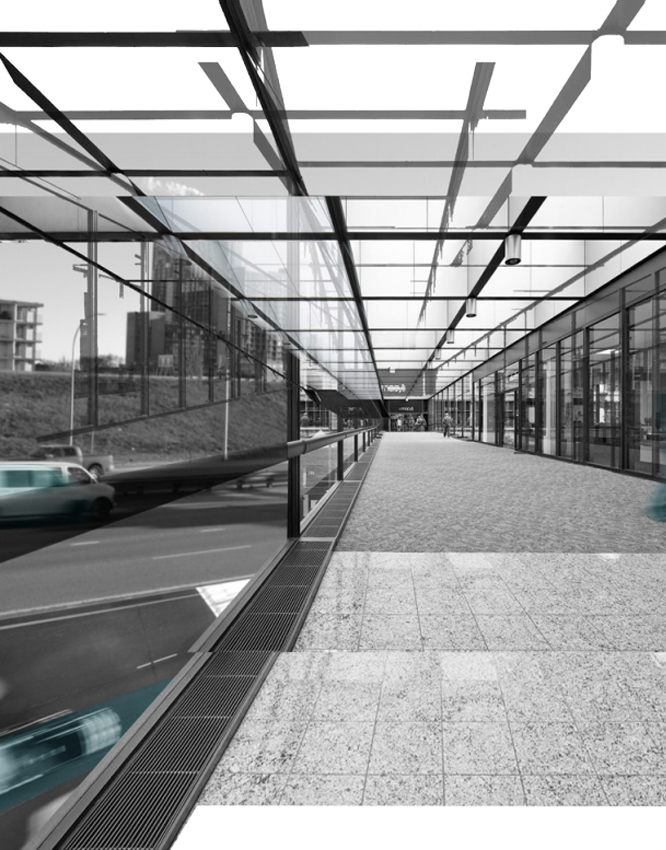
Reflections on two questions.
First, how can we return public land to the public realm? Second, what are the qualities of Terrain Vague, and how might they inform an intervention on a site?
Terrain Vague is used to describe undeveloped urban land that is interstices of the urban context. This land is typically marginalized due to external factors. It is therefore undeveloped and serves as a pause, or a gap, in the city.
By its nature, it is indeterminate. It is uncertain what happens in these areas, where the boundaries are, or what their past contains. In Solà-Morales’ words, these spaces give “the sense of indeterminate, imprecise, blurred, and uncertain”.
Terrain Vague has direct ties to the urban qualities of the city, yet its uncertainty is what leads it to become the “other”. Solà-Morales defines vague from its German roots as, “movement, oscillation, instability, and fluctuation”.
This pause in the urban fabric serves a purpose, as he sees it, in the “expression of our fear and insecurity and our expectation of the other, the alternative, the utopian, the future”. Terrain Vague is important specifically because of the void and its absence of structure. It represents our collective “fleeting relationship between the subject and her/his world, conditioned by the speed with which change takes place.” This condition is being accelerated daily as our experiences are affected by global communication and capital. In the political sphere, this has led to pushes for models of socialism or nationalism as individuals struggle with their identity.
A driving passage for this project has come from one specific paragraph in Solà-Morales’ essay: “Today, intervention in the existing city, in its residual spaces, in its folded interstices can no longer be either comfortable or efficacious in the manner postulated by the modern movement’s efficient model of the enlightened tradition. How can architecture act in the terrain vague without becoming an aggressive instrument of power and abstract reason? Undoubtedly, through attention to continuity: not the continuity of the planned, efficient, and legitimized city, but of the flows, the energies, the rhythms established by the passing of time and the loss of limits...